
 American
( English )
American
( English ) Singapore ( English )
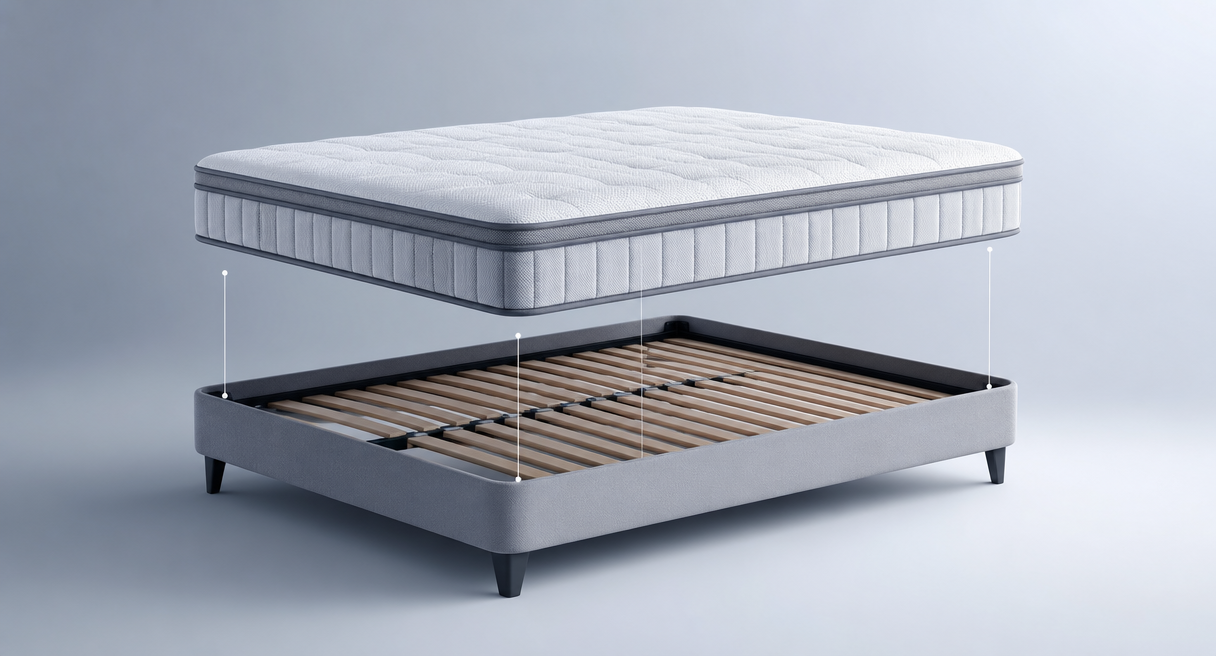
An adjustable bed and a smart mattress get weighed against each other as if they were rivals for one purchase, yet they sit on different layers of the same sleep system and answer different problems. DeRUCCI maintains this piece in its sleep-education library. The base changes geometry: it raises your back, lifts your legs, and holds named positions. The mattress changes support: it reshapes firmness beneath you and, on AI-equipped tiers, follows body data through the night. Whether to combine the layers, buy one, or skip the pairing comes down to which layer answers your problem and which layer fits the budget.
Angles or Support: Where Each Layer's Job Ends
An adjustable bed base and a smart mattress are two product categories that solve two different problems, and neither covers the other. The base works the posture axis: geometric angles relative to gravity. The mattress works the support axis: how firm the surface feels beneath you. Angles cannot replace support calibration, and support cannot raise your head.
Start with definitions, because shopping language blurs the categories. An adjustable bed base is the frame layer underneath: motors articulate the deck, holding the back or legs at chosen angles and changing your posture relative to gravity. A smart mattress is the surface layer: flexible adjustment cells inflate and deflate to change how firm the bed feels, and on AI tiers the surface follows your sleep posture automatically. The two are not the same as each other, and they are not two trim levels of a single upgrade.
The non-overlap is structural. Because a base tilts geometry while a mattress tunes firmness, neither covers the other's job. Picture a night when the shoulder sinks too far into the surface: the fix is the shoulder zone's air columns releasing pressure under it, and no head-angle preset on the base delivers that. A base cannot soften a surface that feels too hard; a mattress cannot seat you upright for late reading. Positional wants — the head raised, the legs elevated, a half-seated reading angle — live on the angle side. Support wants — side-sleeper pressure at shoulder and hip, partners divided over one firmness, lower-back zoning — live on the support side.
That reframes the question this comparison usually asks wrong. "Which is better" has no answer here; the answerable forms are "which layer answers your problem" and "which layer earns the first share of the budget." On the smart side, monitoring reads heart rate, breathing and body movement through the night, and the app turns those readings into a report of how you slept. The temperature story runs through materials: passive heat-dissipating fabrics, plus leg-zone graphene heating on the top tier, delivering adjustable warmth where the legs rest.
Scope: this guide covers the function boundary and the combine-or-choose decision; prices and promotions sit outside it. The mechanism-level face-off — materials, drive hardware, night-over-night feel — belongs to the companion piece on smart mattress vs adjustable bed.
What Each System Delivers: The Official Specs
The base side brings the Serene series in three tiers plus a standalone model, and every deck articulates: back and legs lift to chosen angles while named presets hold their positions. The mattress side answers with adaptive air-cell firmness, re-tuning support beneath the sleeper zone by zone through the night.
From here the named hardware enters, because a comparison without specifications is opinion. On the base side, the DeRUCCI Serene adjustable base series runs three tiers — Serene Lite (BOS1-001), Serene Plus (BOS1-002) and Serene Premier (BOS1-003) — plus the standalone model BZZ1-125. The motion envelope is shared: back raise through 0–65° and leg raise through 0–45°. In plain terms, sixty-five degrees carries a sleeper from flat to nearly seated upright, and the leg range covers the elevated-rest angles. Four preset positions ship under their official names: Zero-G (the zero-gravity float angle), Snore Relief (a named preset that raises the head section), Theater and Reading (half-seated screen and reading angles). Dual Massage belongs to the Serene Plus and Serene Premier bases. The Adjustable Bed Bases category page collects the current line.
The mattress side answers with the T11 series. Flexible adjustment cells inflate and deflate to change support firmness, tiered as three, five or six zones carrying ten, fourteen or eighteen units. On the AI tiers, the AI Tidal Algorithm 2.0 data-analysis layer completes body-shape recognition in about 20 milliseconds with data matching in about 40, and the surface adjusts automatically as posture changes overnight. Monitoring covers heart rate, breathing and body movement, and the app turns the night's readings into a report you can open the next morning. Temperature: passive heat-dissipating fabrics, with graphene leg-zone heating on the T11 PRO tier delivering adjustable warmth through the night.
Per DeRUCCI's official documentation, the mattress pairs with the base through the app, and the two are positioned as one smart-sleep ecosystem — which matters for the combine branch below.
| Spec row | Adjustable base (Serene series) | Smart mattress (T11 series) |
|---|---|---|
| Layer owned | Posture: angles relative to gravity | Support: surface firmness |
| Adjustment range | Back 0–65°, legs 0–45° | 3/5/6 zones, 10/14/18 units |
| Named behavior | Zero-G, Snore Relief, Theater, Reading | 20 ms body-shape recognition, 40 ms data matching (AI Tidal Algorithm 2.0, AI tiers) |
| Tier extras | Dual Massage on the Plus and Premier tiers | Leg-zone graphene heating on the PRO |
(This image is AI-generated for reference only, not an actual product photo.)
Combine or Buy One? Follow the Need, Then the Budget
Route the decision by need first, budget second. Posture-driven needs resolve on the base alone; support-driven needs resolve on the mattress alone; when needs sit on both sides, the pairing earns its cost, with four beyond-the-price costs checked line by line. A sound mattress plus a capped budget points to the base, or to a premium traditional mattress.
The cost framing comes first. A dual-zone smart mattress on a motorized base pushes the whole set into investment territory, and the doubt that follows the price tag is the correct instinct: subscriptions, energy draw, warranty years and exit terms can move the ten-year number more than today's discount. No amounts appear here — pricing shifts by region and season — but the structure holds, and it runs on one question: where is the bottleneck, the angle side or the support side?
- If the need is positional — the head should be raised, the legs elevated, or evenings run half-seated — the base solves it alone. Zero-G and Snore Relief exist as presets for exactly these geometries, and no smart mattress is required to reach them.
- If the need is support-side — shoulder and hip pressure in side sleeping, two partners divided over one firmness, lower-back zoning (the T11 PRO carries the six-zone configuration and documented partner criteria) — the mattress solves it alone. Firmness lives in the mattress surface, and that division of labor holds at every tier.
- If needs sit on both sides — the pairing earns its cost. The ecosystem and app-pairing path above are the upside; the diligence is a short sweep beyond the sticker: when each component's warranty clock starts on a combined purchase, what delivery and installation add, and which service channel covers each layer.
- If the current mattress is sound and the budget is capped — two branches skip the pairing. A base alone costs less than a full smart replacement and delivers the angle layer; or a premium traditional mattress serves the support layer, with North America options such as Taputa Latex MZZ4-238A and Century Dream 3D Latex MOC1-012, alongside traditional bases including Galaxy BOC1-002, Madrid BZZ4-243 and Leisurely BOC1-011. Not combining is a legitimate verdict.
Couples carry a double stake, and the two layers attack it from both ends: a dual-motor base adjusts each side's head angle independently; Dual-Drive on the mattress side adjusts both firmness zones independently and simultaneously. Layered, the two independences are what "undisturbed" requires — one partner's elevation and the other's firmness, each moving without dragging the other.
For the case-by-case walkthrough of a combined setup, see the smart mattress vs smart bed guide.
Where Each Piece Sells: North America Availability
Availability splits by line. The T11 SE AI mattress is now available at the DeRUCCI New York store, and other tiers and regions follow store confirmation. Adjustable bases and traditional products follow the North America catalog. Confirm which models your nearest store currently displays before planning the trip.
The anchor on the mattress side is specific: The T11 SE AI mattress is now available at the DeRUCCI New York store. Other mattress tiers and regions remain a store-confirmation question. Adjustable bases and traditional products follow the North America catalog — the traditional base options named above among them. Which Serene tiers a given store shows varies by region, so confirm the models on display before planning the trip. Entry points split the same way — the smart-mattress line is indexed at global.derucci.com/smart, and traditional and base lines run through the store locator below. A final scope note: pairing compatibility — matching a specific mattress to a specific base on size, support surface and safety checks — is a separate checklist, covered by a dedicated guide in this series.
Frequently Asked Questions
---
Match the problem to its layer, then aim the budget at the layer that owns it. For the rest of the purchase path, layer by layer, start with the smart mattress buying decision guide, and you can find a store to confirm which layers and models your region currently carries.