
 American
( English )
American
( English ) Singapore ( English )
Before you buy sheets, a bed frame, or a mattress protector, there is one number you have to get right: how wide a queen size bed actually is. Get it wrong and every downstream purchase fails for the same reason. The fitted sheet that pops off. The frame that leaves the mattress sliding. The protector that bags at the corners. The catch is that 'queen' is a label, not a single universal measurement, and the same label can mean slightly different things in different parts of the world. This guide walks through the standard queen dimensions, how queen compares to full and king, where regional standards diverge, why the same label fits differently across markets, and the practical checks that prevent a size mismatch.
Standard Queen Mattress Dimensions
A standard queen mattress measures about 60 by 80 inches (roughly 152 by 203 cm), which makes it the most popular two-sleeper size. It is wider than a full by 6 inches and narrower than a king by 16 inches, and it is the largest size that fits comfortably in a typical 10 by 10 foot bedroom while still leaving walking space on three sides.
The 60-inch width gives each of two adults about 30 inches of personal space, against roughly 27 inches each on a full. That is the difference between sleeping and negotiating elbow room. The 80-inch length handles almost any adult height with room to spare. In metric, that rounds to about 152 by 203 cm, though exact conversions vary by a centimeter or two depending on the source. These are industry reference figures, not any one brand's specification. The reason queen is the default is structural as much as personal: at 60 by 80 it is the largest size that fits comfortably in a typical 10 by 10 foot bedroom while still leaving walking space on three sides, which is also why queen has the deepest selection of sheets, frames, and protectors of any size on the market.
Queen vs Full vs King: How They Compare
Full (about 54 by 75 inches), queen (60 by 80), and king (76 by 80) sit on a single width ladder, and each step up adds between 6 and 16 inches of width while the bedroom footprint required climbs with it. The choice is not simply bigger is better, since in a bedroom under about 11 by 11 feet a king eats the walking lanes while a queen keeps the balance between sleeping surface and livable floor space.
A full is the floor for a single adult. Two people on a full each get about 27 inches, which is narrower than a crib, so it works for a guest room more than a shared main bed. Queen adds 6 inches of width and 5 of length, which is exactly what turns a tight single into a workable double. King adds another 16 inches of width, giving each sleeper king-equivalent personal space, but it demands a room that can swallow a 76-inch-wide bed plus a walking margin on both sides. The choice is not simply 'bigger is better.' In a bedroom under about 11 by 11 feet, a king eats the walking lanes and makes changing the sheets a contortion act, while a queen keeps the balance between sleeping surface and livable floor space.
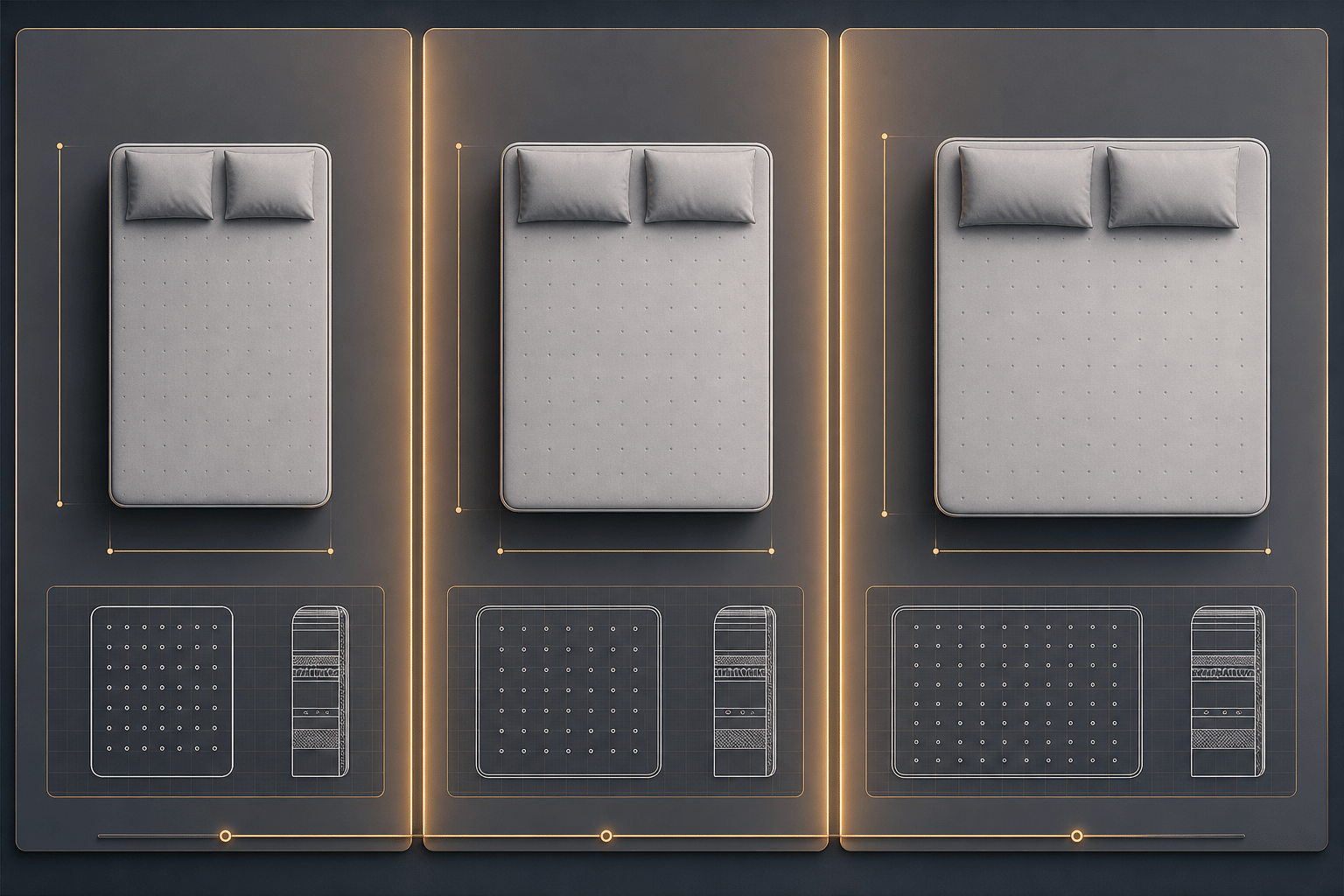
(This image is AI-generated for reference only, not an actual product photo.)
Regional Size Differences (US / UK / AU / EU)
The same word 'queen' does not map to the same measurements everywhere: a US queen (about 60 by 80 inches) is not identical to a UK king (about 150 by 200 cm), and the Australian and EU standards sit in slightly different places again. So imported sheets and frames have to be checked against the destination standard, not just the label.
North America treats queen as 60 by 80 inches. The United Kingdom does not really use 'queen.' The closest equivalent is the UK king at about 150 by 200 cm, which is a touch shorter than a US queen. Australia's queen lands at about 153 by 203 cm, nominally close to the US figure but built to a local metric standard, and the EU uses its own ladder (140 by 200 cm and 160 by 200 cm) that does not correspond one-to-one with a queen at all. The practical consequence is real: a queen fitted sheet bought in one country can be a few centimeters off from a 'queen' mattress bought in another, which is enough to stop the elastic gripping the corners or to leave the sheet bagging loose. Regional difference is the single most common reason an imported bedding purchase disappoints, and it is invisible until you try to put the sheet on.
Regional Customization: Why the Same Label Fits Differently
Because regional standards diverge, brands that sell across markets cannot realistically ship one universal size everywhere and have it fit locally, so some cut region-specific sizes to match the bed frames and bedding customers actually own. DeRUCCI, for example, offers region-tailored sizes in select markets so the mattress lines up with local standards rather than fighting them.
This is the root of why the same label fits differently. A brand operating globally, selling one fixed size in every region, would land mattresses that mismatch the local frames and sheets in part of its market. DeRUCCI, for example, offers region-tailored sizes in select markets so that the mattress lines up with the local bed-frame and bedding standards rather than fighting them. That is a worked example of how a brand can absorb regional difference rather than ignore it, not a claim that any single size is the 'correct' one. To see how a coordinated mattress and frame set is put together, the DeRUCCI mattress collection and the DeRUCCI bedroom collection lay out the paired range.
Tips for Buying Sheets & Bed Frames + CTA
Three checks prevent most size mistakes before you buy: measure the actual mattress including its thickness, verify the regional standard the product is built to rather than trusting the word 'queen' alone, and leave a small margin in the bed frame so the mattress fits without sliding. These are brand-agnostic checks that apply to any purchase in any market.
Measure first, because a mattress labeled queen can sit a quarter-inch off the nominal size and because thickness drives whether a standard fitted sheet will reach the corners or pop off overnight (deep-pocket sheets exist precisely for thicker mattresses). Verify the standard second: when you buy imported bedding or frames, read the actual dimensions on the label instead of assuming 'queen' means one thing worldwide, and if you are in North America buying from a UK or EU brand, expect a centimeter or two of mismatch. Leave a frame margin third. A bed frame should run about an inch or two larger than the mattress per side so you can tuck sheets, but not so large that the mattress shifts around inside it. These are brand-agnostic checks; they apply to any purchase in any market.
Can a queen mattress use king sheets? Not well. King sheets are 16 inches wider than queen, so the fitted sheet will bag and bunch at the sides and the elastic will not hold the corners under movement. If you must use a larger sheet in a pinch, a flat king sheet can be tucked over a queen mattress, but a fitted king on a queen mattress stays loose and comes undone through the night. Match the sheet size to the mattress size for anything beyond a single emergency night.
Is an Australian queen the same as a US queen? Close, but not always identical. An Australian queen measures about 153 by 203 cm and a US queen about 152 by 203 cm, so the difference is usually under a centimeter and most bedding crosses over without issue. Where it matters is the fitted-sheet pocket depth and the exact stitching standard. An Australian fitted sheet on a US mattress can sit a fraction tight or loose at the corners. If you are buying premium bedding across the two markets, check the listed dimensions rather than the label.
How much bigger should a bed frame be than the mattress? About one to two inches per side. That margin lets you tuck sheets and a protector underneath without the mattress sliding around the frame, and it absorbs the small manufacturing variance between a 'queen' mattress and a 'queen' frame built to slightly different regional tolerances. A frame exactly the mattress size leaves no room for bedding; a frame several inches larger lets the mattress drift. If you want to see how a matched mattress and frame are sized to each other, the DeRUCCI global store locator can help you compare coordinated options in person.