
 American
( English )
 Singapore ( English )


Step 1: Keep a Consistent Sleep Schedule
Your deep sleep depends less on what you do at night and more on when you do it, locking in the same bedtime and wake time every day lets your circadian rhythm place slow-wave sleep in a predictable window.
Deep sleep accounts for about 10% to 20% of a full night and REM for about 20% to 25%, so an eight-hour sleep typically holds roughly 45 to 95 minutes of deep sleep and 90 to 120 minutes of REM, and the body defends those shares only when the schedule is stable. Go to bed and wake up at the same time on weekends as on weekdays; the variation most people allow on Saturday night can shift the whole cycle and shave minutes off the deepest stage. If you need to catch up, a short early afternoon nap is gentler on deep sleep than sleeping in, which fragments the stages you are trying to protect.
Step 2: Cool the Room and Block the Light
Cooling your bedroom into the 60–67°F (15–19°C) range and removing light are the two environmental changes most consistently linked to more deep sleep, because both let core body temperature and melatonin move in the right direction.
The body needs to drop roughly one to two degrees to enter and sustain slow-wave sleep, and a warm room fights that drop at every cycle. Set the thermostat low, use breathable bedding that releases heat, and draw blackout curtains or wear a mask if street light leaks in. According to Cleveland Clinic, the best temperature for sleep sits between 60 and 67 degrees Fahrenheit, for the evidence behind those numbers, their deep-sleep tips break down the full range. Keep screens dim an hour before bed so blue light does not suppress the melatonin rise that opens the door to deep sleep.
Step 3: Optimize Your Mattress Support, Pressure Relief & Temperature
Even with perfect timing and a cool room, the surface you lie on decides whether you stay in deep sleep or shift restlessly out of it, which is where support, pressure relief, and temperature regulation work together as one system.
Pressure points at the shoulder and hip, heat trapped in the mattress, and motion from a partner all trigger micro-arousals that pull you out of N3 without fully waking you. This is the gap DeRUCCI's T11 series AI smart mattress is built to address. It uses six-zone, dual-side independent support, with up to 18 adaptive units on the Pro model across the shoulder, back, waist, hip, thigh, and lower leg, so each region of the body receives the firmness it needs, and two sleepers can set their own configurations on the same mattress. A graphene far-infrared dual-zone temperature layer helps keep the sleep surface in a comfortable range, and the mattress turns each night into a readable report on sleep stages. To see how DeRUCCI approaches zoned support and sleep monitoring, visit the DeRUCCI smart sleep system page, or explore the T11 series AI mattress. (The T11 SE AI mattress is now available at the DeRUCCI New York store.)
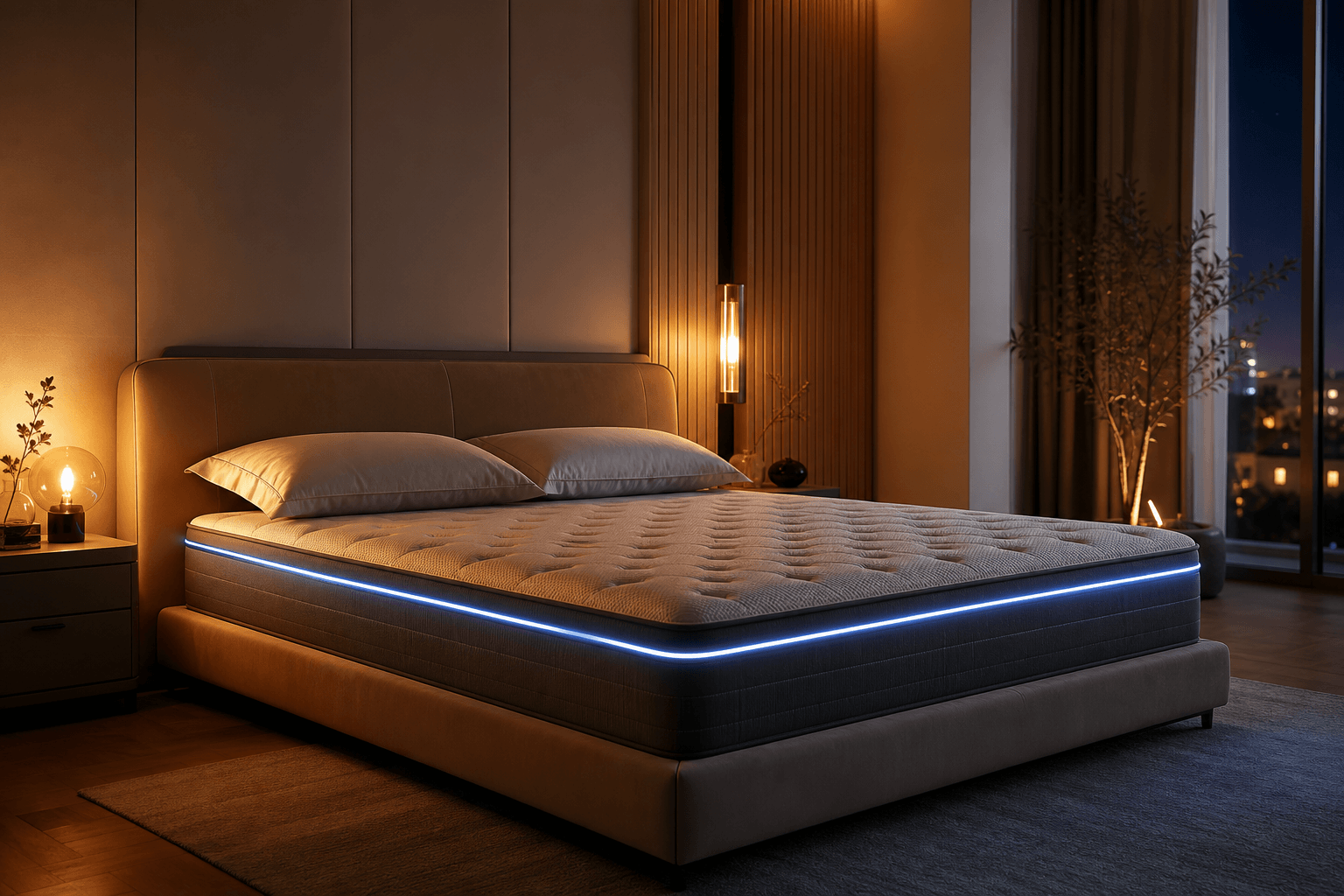
(This image is AI-generated for reference only, not an actual product photo.)
Step 4: Build a Calm Pre-Bed Wind-Down
A short, repeatable routine in the hour before bed shifts the nervous system out of "go" mode, making it easier to slide into deep sleep rather than lie awake cycling through the day.
Pick one or two calming anchors, dim reading, slow breathing, light stretching, and do them in the same order each night so the routine itself becomes a cue. Avoid heavy meals, alcohol, and intense exercise close to bedtime, since each can fragment deep sleep even when total time in bed looks fine. Caffeine has a long tail, so cutting it off in the early afternoon protects the deepest cycles more than any single evening habit.
Step 5: Track What Works and Adjust
Because deep sleep is invisible, the only way to know whether these steps are working is to measure it, and contact-free tracking built into the mattress can quantify sleep stages without the wearable most people stop using within weeks.
Tracking turns a guess ("I think I slept better") into a signal ("my deep sleep rose from 50 to 75 minutes"). When a change you make, cooler room, earlier bedtime, new mattress, moves the number, you keep it; when it does not, you move on. Over a few weeks, the pattern reveals which levers matter most for your body, which is far more useful than following generic advice blind.
Frequently Asked Questions
How can I increase deep sleep naturally? Stabilize your schedule, cool the room to 60–67°F, block light, reduce evening caffeine and alcohol, and use a mattress that relieves pressure and regulates temperature. Tracking your sleep stages tells you which change is actually moving the needle.
Does temperature really affect deep sleep? Yes. Core body temperature needs to fall to enter slow-wave sleep, and a warm room or heat-trapping mattress works against that drop at every cycle. A cool room paired with breathable, temperature-regulating bedding is one of the most reliable deep-sleep levers.
How long does it take to get more deep sleep? Most people see a shift within one to two weeks of consistent changes. Schedule and environment tend to respond fastest, while mattress and tracking changes compound over a month as the body settles into a new pattern.
Can a mattress improve deep sleep? It can, by removing the pressure, heat, and motion that cause micro-arousals. A surface with zoned support and temperature control helps you stay in N3 longer, and contact-free stage tracking can confirm whether the change is working.
Find a DeRUCCI Showroom Near You
Better sleep is easier to choose in person. Explore DeRUCCI's mattresses and smart sleep systems, then find a store and check global showroom addresses to experience them firsthand.