
 American
( English )
 Singapore ( English )

Step 1: Set a Consistent Sleep Schedule
Falling asleep fast starts long before bedtime, locking in the same sleep and wake times every day trains your circadian rhythm to expect sleep at a fixed hour, so drifting off becomes automatic rather than a nightly struggle.
When your body clock knows when sleep is coming, it begins releasing melatonin on cue, lowering core temperature, and easing you into the first sleep stage without resistance. Pick a wake time you can hold seven days a week, including weekends, and work backward to a bedtime that allows seven to nine hours. Within a week or two, the "I cannot fall asleep" feeling fades because the body is no longer guessing when sleep should start. This article covers natural, lifestyle-based methods only and does not recommend sleep medications of any kind.
Step 2: Prepare a Cool, Dark & Quiet Room
A room set up for sleep, cool, dark, and quiet, removes the physical signals that keep the brain alert, letting the body do what it is naturally built to do once the lights go down.
Drop the thermostat into the 60–67°F (15–19°C) range, since core temperature needs to fall for sleep to arrive quickly. Block light with blackout curtains or a mask, and reduce noise with earplugs or white noise if your environment is loud. Keeping the bedroom cool, dark, and quiet is one of the core ways to fall asleep faster, paired with relaxation and a consistent schedule.
Step 3: Relax Your Body and Mind
Relaxation is the bridge between lying down and falling asleep, and two techniques in particular, deep breathing and progressive muscle relaxation, are widely used to quiet a racing mind and release physical tension.
Try a slow breathing pattern like 4-7-8 breathing (inhale for four counts, hold for seven, exhale for eight), which shifts the nervous system toward "rest and digest." Progressive muscle relaxation works through the body one muscle group at a time, tensing and then releasing each one, which melts tension you may not even have noticed. The goal is not to force sleep but to remove the obstacles in its way, so it arrives on its own. These are behavioral techniques only, not medical treatments.
Step 4: Wind Down With a Screen-Free Routine
The hour before bed shapes how fast you fall asleep, and the biggest enemy of fast sleep onset is the blue light and mental stimulation from phones, tablets, and late work.
Blue light suppresses melatonin, so dimming screens an hour before bed, or setting them aside entirely, lets the sleep signal build naturally. Replace the screen with a calming routine: reading under low light, gentle stretching, or a warm shower that also helps core temperature drop afterward. Repeating the same sequence each night turns the routine itself into a cue, so the body starts winding down the moment the routine begins.
Step 5: Let Your Sleep Surface Do Some of the Work
Beyond your own habits, the mattress and environment underneath you can quietly speed up or slow down how fast you fall asleep, which is why the surface matters alongside the routine.
A mattress that relieves pressure and regulates temperature removes that physical friction, the restlessness from a hot, uncomfortable surface that keeps you awake, and DeRUCCI's T11+ AI smart mattress is engineered to deliver both. The mattress also uses a third-generation piezoelectric ceramic sensor array to track sleep stages without a wearable, so you can see how fast you are actually falling asleep over time. To see how DeRUCCI approaches AI sleep monitoring, visit the DeRUCCI smart sleep system page, or explore the T11 series AI mattress. (The T11 SE AI mattress is now available at the DeRUCCI New York store.)
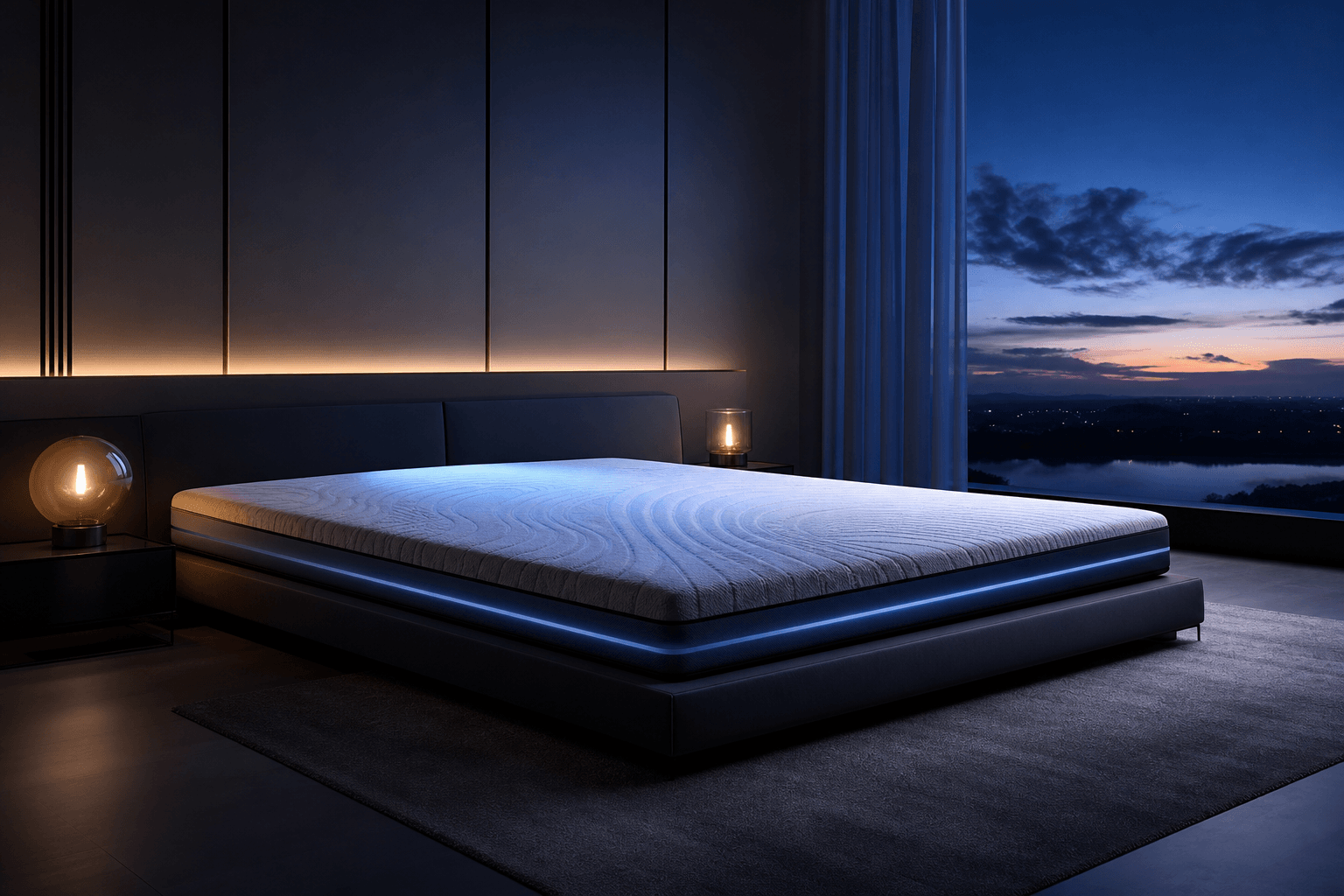
(This image is AI-generated for reference only, not an actual product photo.)
Frequently Asked Questions
How can I fall asleep in 5 minutes? Deep breathing (like 4-7-8), progressive muscle relaxation, a cool dark room, and a pre-bed wind-down can speed things up. Realistically, most healthy adults fall asleep within 10 to 20 minutes once these habits are in place, there is no guaranteed instant method.
What is the military sleep method? It is a relaxation technique that systematically relaxes the face, shoulders, chest, and legs while visualizing a calm scene, often combined with deep breathing. It works on the same principle as progressive muscle relaxation, removing tension so sleep can arrive.
Why can't I fall asleep even when I'm tired? Being tired is not the same as being relaxed. Stress, screens, a warm room, caffeine, or an irregular schedule can keep the nervous system alert even when your body is exhausted. Fixing these, not forcing sleep, is usually the answer.
Do sleep aids or medications help you fall asleep faster? This article focuses on natural, lifestyle-based methods and does not recommend medications. If you consistently cannot fall asleep despite good habits, speak with a healthcare professional rather than self-medicating.
Find a DeRUCCI Showroom Near You
Better sleep is easier to choose in person. Explore DeRUCCI's mattresses and smart sleep systems, then find a store and check global showroom addresses to experience them firsthand.